
If you’ve spent a summer in Central New York, you already know the feeling. It’s 80 degrees outside, and the air feels like a warm, wet towel wrapped around your face. That’s not just heat; that’s humidity, and it doesn’t stop at your front door.
Syracuse summers are consistently among the most humid in the Northeast, with dew points regularly climbing into the upper 60s and low 70s. At those levels, your home can quietly absorb enough moisture to create real problems: mold in the basement, condensation on walls, peeling paint, and that relentless sticky feeling that no amount of air conditioning seems to fix.
Understanding why that happens and what to do about it starts with your indoor humidity levels.
What “High Indoor Humidity” Actually Means
The Environmental Protection Agency recommends keeping indoor relative humidity between 30% and 50%. Once it creeps above 50%, the conditions become favorable for mold growth, dust mite populations increase, and wood floors and furniture can begin to warp. Above 60%, you’re in a range where mold can develop on surfaces within 24 to 48 hours.
Common signs your home’s humidity is too high include:
- Condensation on windows: Moisture forming on the inside of the glass, especially in the morning, indicates excess water vapor in the air.
- A musty smell in the basement: That damp, earthy odor is one of the earliest indicators of mold or mildew activity.
- Sticky or clammy skin indoors: When the air is saturated, sweat doesn’t evaporate efficiently, leaving you uncomfortable even at a reasonable thermostat setting.
- Visible mold or mildew: Dark spots on grout, drywall, or ceiling tiles are a sign the problem has already taken hold.
- Worsening allergy symptoms: Dust mites and mold spores thrive in humid environments and are among the most common household allergens.
If any of these sound familiar, a dehumidifier may be part of the solution. The next question is which type makes sense for your home.
Portable Dehumidifiers vs. Whole-Home Systems
Portable dehumidifiers are affordable and easy to find at any hardware store. For a single problem area, such as a damp corner in a finished basement, they can do the job. But they come with trade-offs.
Most portable units are only rated for spaces up to 1,500 to 2,000 square feet, require you to manually empty a water reservoir every day or two, generate heat as they operate, and run loud enough to be disruptive in living spaces. If you have a 2,000-square-foot home with humidity issues on multiple floors, you’d need several units running constantly.
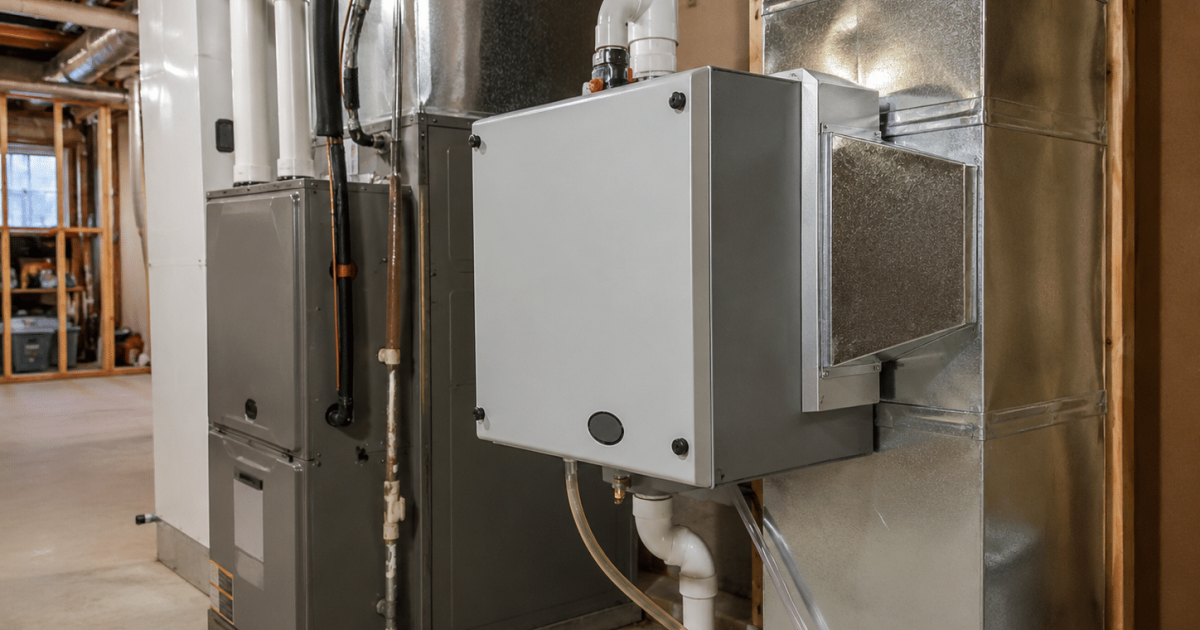
A whole-home dehumidifier integrates directly into your existing HVAC system and treats every cubic foot of conditioned air in the house. It drains automatically to a floor drain or a condensate line, operates quietly, and is controlled by a single humidistat, often connected to your existing thermostat. The Air Conditioning Contractors of America notes that properly sized dehumidification systems can significantly reduce the load on your air conditioner, since your AC no longer has to work as hard to cool air that’s already been stripped of excess moisture.
For most Syracuse homeowners dealing with whole-house humidity above 50%, a whole-home system isn’t just more convenient; it’s more effective.
How Whole-Home Dehumidification Works With Your HVAC
Your central HVAC system already removes some moisture as a byproduct of cooling. Air passes over a cold evaporator coil, moisture condenses out of it, and the water drains away. The problem is that standard AC systems are designed to control temperature, not humidity. On cooler, overcast days when you don’t need much cooling, the system may not run enough to adequately dehumidify.
A whole-home dehumidifier solves this by operating independently of your AC. It can run on humid days even when the temperature doesn’t call for cooling, maintaining your target humidity level year-round. This is especially valuable in Syracuse’s spring and fall shoulder seasons, when temps are moderate, but the air is still damp.
If you’re interested in indoor air quality services more broadly, dehumidification is often one piece of a larger picture that includes air filtration and ventilation.
Is Your Home a Good Candidate?
A whole-home dehumidifier tends to be a good fit if:
- Your home is larger than 2,000 square feet
- You have a finished or semi-finished basement
- You notice humidity problems on multiple floors or in multiple rooms
- Your portable dehumidifier runs constantly and still can’t keep up
- You or a family member has allergies or respiratory sensitivities
Homes with newer, tightly sealed construction are especially prone to humidity buildup because there’s less natural air exchange. If your home was built or significantly renovated in the last 20 years, this is worth paying attention to.
A licensed HVAC technician can assess your current system, measure your actual indoor humidity levels, and recommend the right capacity unit for your square footage. Whole-home dehumidifiers are typically sized in pints per day, and getting that number right matters — too small and it won’t keep up, too large and you risk over-drying the air in winter.
Scheduling a maintenance visit is a natural time to have this conversation, since a tech will already be evaluating your system’s overall performance.
Take Control of Your Indoor Air This Summer
Hummingbird Heating and Cooling serves homeowners across the Syracuse area and Central New York, and humid summers are something the team deals with every season. Whether you’re dealing with a musty basement, sticky air, or a portable dehumidifier that just can’t keep up, Hummingbird can help you find the right solution for your home’s size and setup. Contact Hummingbird online to schedule a consultation.
FAQs About Whole-Home Dehumidifiers
What humidity level should I keep my home at in Syracuse summers?
The EPA recommends keeping indoor relative humidity between 30% and 50%. During humid Central New York summers, maintaining the lower end of that range (around 45% to 50%) helps prevent mold growth, reduces dust mite activity, and keeps the home more comfortable. A whole-home dehumidifier with a humidistat makes it easy to hold a consistent target level.
Can a whole-home dehumidifier help reduce my energy bills?
It can. When your air conditioner has to remove excess moisture in addition to cooling the air, it works harder and runs longer. A whole-home dehumidifier handles the moisture independently, which can reduce the load on your AC and improve overall system efficiency. The savings vary depending on your home’s size and the humidity of your baseline conditions, but many homeowners notice a difference in their summer utility bills.
How is a whole-home dehumidifier installed?
A whole-home dehumidifier is typically installed by a licensed HVAC technician and integrated into your existing ductwork and central air system. The unit connects to a drain line for automatic water removal, and a humidistat is wired in to control operation. Installation usually takes a few hours and doesn’t require major modifications to your existing system.
